
Aleppo: Syria's Commercial Capital — Ancient Souks, Grand Mosques & Investment Opportunity
Aleppo's 8,000-year history as a trading crossroads makes it Syria's most commercially vibrant city. Discover its ancient covered souks, Ottoman khans, towering mosques, and why savvy investors are watching closely.
Aleppo — Eight Thousand Years of Commerce
Aleppo (Halab) is one of the oldest continuously inhabited cities on earth, with evidence of settlement dating back 8,000 years. Positioned at the northern end of Syria's fertile crescent and the gateway between the Mediterranean and Mesopotamia, Aleppo has been a commercial powerhouse since before recorded history. Its DNA is mercantile — every stone of its ancient city breathes trade, enterprise, and accumulated wealth.
Today, as Syria enters a new phase of reconstruction and economic reopening, Aleppo's commercial heritage positions it uniquely for recovery and growth. For investors willing to look past the recent chapter of its long story, Aleppo offers perhaps the most compelling large-city opportunity in the Arab world.
The Covered Souks — The World's Longest Ancient Market
At the heart of Aleppo's UNESCO-listed Old City lies its famous covered market system — Al-Madina Souks — stretching over 13 kilometres of vaulted stone arcades. Declared the longest ancient covered market in the world, this labyrinthine commercial complex has operated continuously for over 1,000 years. Specialized souks are dedicated to silk, cotton, copper, gold, spices, wool, leather, and soap — Aleppo's famous laurel-oil soap (ghar soap) being one of the world's most prized artisanal products, exported across Europe for centuries.
The souks were severely damaged in recent years but are now the focus of massive international restoration efforts led by UNESCO, the Aga Khan Trust for Culture, and the German government. Commercial properties within and adjacent to the restored souk network represent long-term holds with extraordinary appreciation potential.
The Ottoman Khans — Aleppo's Commercial Architecture
Surrounding the souks, Aleppo's khans (caravanserais) represent the highest achievement of Ottoman commercial architecture. Built between the 16th and 18th centuries to house merchants, their goods, and their animals, these massive structures — built around open courtyards — are architectural masterpieces. Among the most impressive:
- Khan al-Wazir — built in 1682, with an elaborately carved black-and-white stone portal considered one of the finest in the Islamic world
- Khan al-Gumruk (Customs Khan) — the largest in Aleppo, once the center of European consular life and Levantine trade
- Khan al-Nahasin (Coppersmiths' Khan) — still the heart of Aleppo's metalwork trade
- Khan al-Saboun (Soap Khan) — dedicated to Aleppo's famous laurel soap trade with Europe
Several khans are being converted to boutique hotels and cultural centers — a hospitality investment model that has proved highly successful in similar heritage cities.
The Great Mosque of Aleppo — Umayyad Heritage
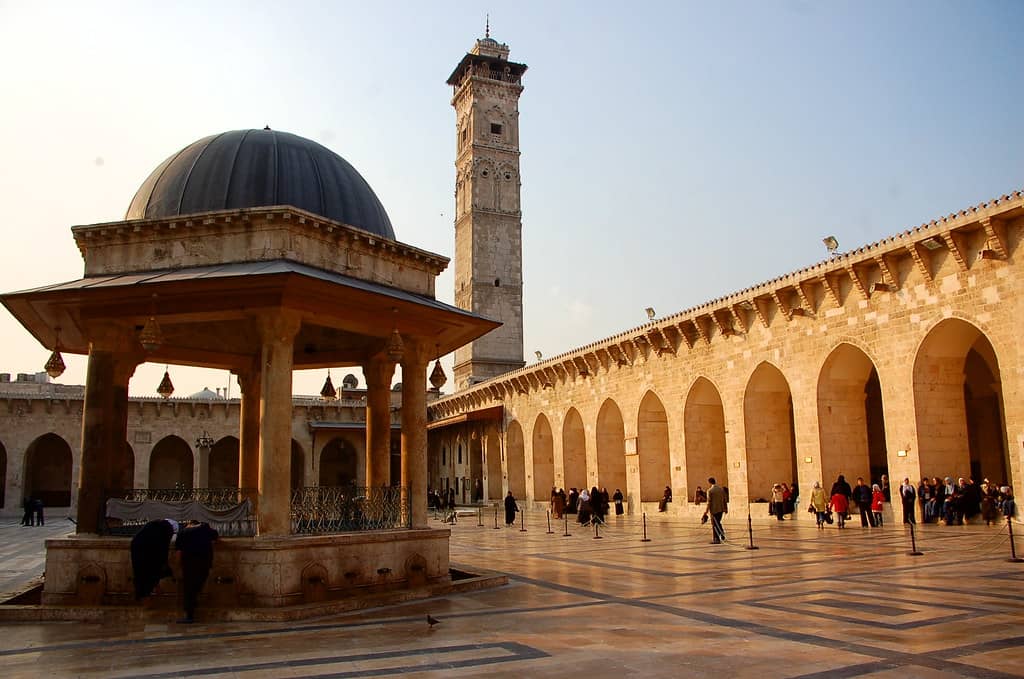
The Great Mosque of Aleppo (al-Jami' al-Kabir) was founded in the early Umayyad period and expanded by successive Islamic dynasties over 1,400 years. Its distinctive 11th-century minaret — a masterwork of Islamic stone carving standing 45 metres high — was one of the most celebrated in the Arab world before suffering damage in recent years. Restoration of the minaret has become a symbol of Aleppo's cultural recovery. Properties in the immediate vicinity of the mosque — one of the most visited sites in Syria — carry permanent heritage value.
The Citadel of Aleppo — The Fortress Above the City
Rising 50 metres above the surrounding plain on a massive artificial tell accumulated over 3,000 years, the Citadel of Aleppo is one of the oldest and largest castles in the world. Its massive sloping stone glacis, monumental bridge, and Ottoman throne room create a silhouette visible from across the city. The UNESCO-listed citadel anchors Aleppo's skyline and identity — and properties with citadel views command premiums in Aleppo's real estate market.
Churches, Temples, and Religious Diversity
Aleppo's extraordinary religious diversity is expressed in its architectural landscape:
- Cathedral of Saint Elias (Melkite Catholic) — one of the largest Christian churches in the Middle East
- Armenian Cathedral of the Forty Martyrs — heart of Aleppo's 100,000-strong Armenian community
- Syriac Orthodox Archdiocese — Aleppo has the largest Syriac Christian population outside India
- Al-Khusrawiyya Mosque — Aleppo's most elegant Ottoman mosque, designed by Mimar Sinan's school
- Al-Bahramiyya Mosque — exquisite 17th-century Ottoman architecture
- Al-Saffahiyya Mosque — Mamluk-era calligraphy and geometric tile work
This concentration of faiths — Muslim, Christian, Armenian, Syriac, Kurdish — in a single city creates a cultural richness that few cities on earth can match, and attracts diaspora buyers from across all communities.
Aleppo's Modern Commercial Districts
Beyond the historic core, Aleppo's modern commercial districts offer different investment profiles:
- Al-Azizieh: Aleppo's most prestigious residential and commercial neighborhood — wide tree-lined streets, French Mandate architecture, upscale retail
- Al-Sha'ar and Al-Kallaseh: Traditional commercial districts transitioning to mixed retail and residential
- Western Aleppo suburbs: Newer residential developments attracting returning families and young professionals
- Industrial zone (Sheikh Najjar): One of the largest industrial cities in the Arab world, currently being rebuilt as a hub for Syrian manufacturing recovery
The Investment Case for Aleppo Today
Aleppo's commercial and real estate recovery follows a simple logic: a city with 8,000 years of commercial DNA, 2 million inhabitants, the world's longest ancient covered market, and a strategic location between Turkey, Lebanon, and Iraq does not permanently decline. The question is timing — and the evidence suggests that timing is now:
- Major international restoration programs are actively rebuilding the historic core
- Syrian manufacturers are returning to Aleppo's industrial zone
- The diaspora — over 500,000 Aleppans worldwide — is actively monitoring the market
- Commercial property prices remain at historic lows relative to long-term fundamentals
- Heritage hospitality conversions in restored khans and old city properties are beginning
For investors with a 5–10 year horizon, Aleppo offers what emerging market investors seek: a fundamentally sound asset at a deeply discounted price, in a city too historically significant to remain undervalued.
Explore commercial and residential properties in Aleppo on AqaarGate — Syria's #1 real estate platform.