
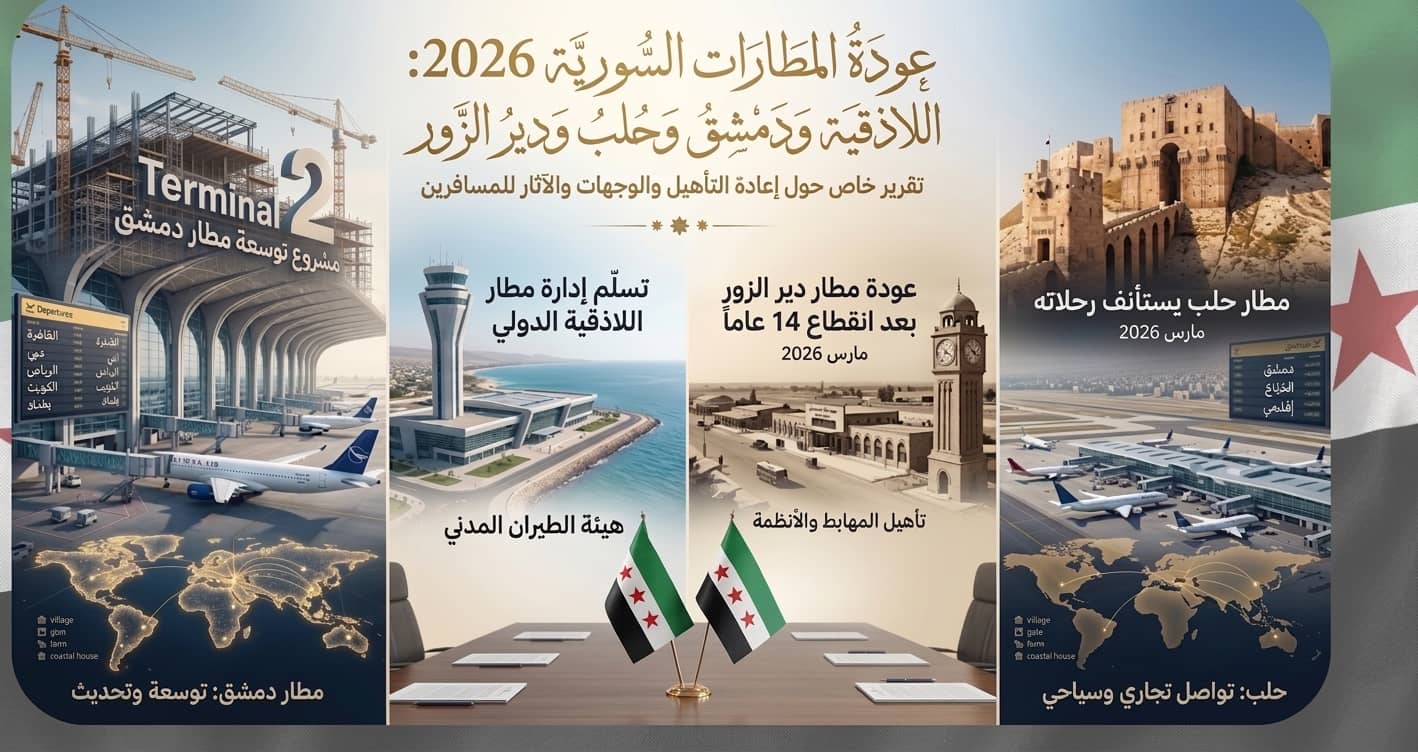
Syria's Airports in 2026: Latakia, Damascus, Aleppo, Deir ez-Zor
After years of suspension, Syria's airports are gradually returning to service. Aleppo resumed flights in March 2026, Deir ez-Zor reopened following a 14-year gap, and civil aviation authorities have taken over Latakia International ahead of its return — while Damascus undergoes a major expansion. Here's where each airport stands, which routes are actually available, and what it means for travellers and expatriates.
Syrian Airports Reopening: What Latakia, Damascus, Aleppo & Deir ez-Zor Mean for Real Estate
In Syria, an airport is never just a terminal. It is a city's gateway, an artery for trade and tourism, and one of the factors that directly shapes the value of the areas around it.
That is why the return of several Syrian airports to service matters well beyond the aviation sector. It is a development that could affect the movement of Syrians and expatriates, tourism, trade, investment — and ultimately the property market.
In this AqaarGate analysis, we look at what the reopening of Latakia, Damascus, Aleppo and Deir ez-Zor airports could mean — without hype, and with a realistic view of both the opportunities and the limits.
What This Article Covers
- The current status of each of the four airports
- How transport infrastructure influences property demand
- Five real estate segments that could benefit from better air access
- Why an airport opening does not automatically raise prices
- The indicators investors should actually track
Latakia International Airport: Small Airport, Strategic Location
Latakia's airport draws its importance from its position on the Syrian coast and its proximity to the cities of Latakia and Tartus.
In August 2026, the General Authority for Civil Aviation and Air Transport announced it had taken over management of the airport and begun the procedures required to return it to service within Syria's civil aviation system, while local authorities continue completing the technical and operational requirements.
Why It Matters to Coastal Residents
For residents of Latakia, Tartus, Jableh and the surrounding areas, the airport's return means something simple but significant: shorter journeys, less time, lower cost.
A traveller from the coast may currently need to use alternative airports and pass through transit hubs before reaching their destination. An active international airport close to the coastal cities opens the door to direct flights to regional and European destinations — provided airlines, operational viability and the necessary approvals are in place.
This is not merely theoretical: Latakia's airport was historically connected to a network of international destinations, including several European cities.
The Geographic Advantage
The airport sits roughly 20–23 kilometres from central Latakia — a relatively short distance that makes it practical for residents across the coastal region.
Damascus International Airport: The Main Gateway and Its Expansion
Damascus International remains the single most important element of Syria's air transport infrastructure, given the capital's role as the country's political, economic and administrative centre.
The conversation today extends beyond reopening to a major development project covering new passenger terminals, upgrades to air and ground infrastructure, improved cargo and logistics systems, and a better passenger experience. Plans have been announced targeting a capacity of approximately 31 million passengers per year once all phases are complete.
The Economic Dimension
A modern airport serves more than travellers. It can anchor an ecosystem of hotels, restaurants, transport companies, car rental, logistics services, warehousing and offices.
This is where the property link becomes direct: areas well connected to airports and main roads typically become more attractive for both commercial and residential development.
Aleppo International Airport: Gateway to Northern Syria
Aleppo International Airport returned to service in March 2026, alongside the opening of air corridors in the northern sector, with flights subsequently resuming on several routes.
The significance is twofold. Aleppo is a historic commercial and industrial centre, and a functioning airport there supports business travel, commercial visits, air freight and tourism. The airport also serves not only the city but wide areas across northern Syria, reducing the need for long overland journeys.
Deir ez-Zor International Airport: The Eastern Gateway Returns
In August 2026, Deir ez-Zor International Airport returned to service after a suspension lasting roughly 14 years, with domestic and international flights resuming following maintenance and rehabilitation work.
The step carries particular weight given the governorate's position in eastern Syria, reconnecting it to the air transport network and easing movement for residents, business travellers and investors.
Why Syria Needs a Network, Not a Single Airport
Real strength lies not in one upgraded airport but in an integrated network:
- Damascus (south & centre): primary gateway and logistics hub
- Aleppo (north): commercial and industrial window
- Latakia (coast): tourism and Mediterranean gateway
- Deir ez-Zor (east): connection point for the eastern region
Such a network makes travel within Syria — and between Syria and the world — considerably more flexible. Instead of a coastal traveller heading south, they use a nearby airport. Instead of the north depending entirely on the capital, Aleppo resumes its role.
What This Means for Syrian Expatriates
For expatriates, the calculation is not just the ticket price. It also includes:
- Journey duration and number of transit stops
- Cost of reaching the airport and waiting time
- Proximity of the airport to the city and family
- Ease of returning to one's area of origin
- Availability of flights at convenient times
Multiple functioning airports and the return of direct routes could make visiting Syria meaningfully easier, particularly for the large Syrian communities in Europe and the Gulf. The resumption of direct flights between Syria and Germany via German carriers in July 2026 signalled the beginning of a broader restoration of European air links.
From Airport to Property: Five Segments That Could Benefit
1. Tourism Property
Particularly along the coast, where better air access supports tourism and short-term rentals.
2. Apartments Aimed at Expatriates
An expatriate who can reach their city more easily may be more willing to buy, retain a family property, or invest in a holiday home.
3. Hotels and Serviced Apartments
Higher passenger movement means potential accommodation demand — if matched by real tourism and commercial activity.
4. Commercial Real Estate
Restaurants, offices, service centres, transport companies, car rental and logistics operations.
5. Land Along Transport Corridors
As roads connected to airports improve, areas on main corridors may gain in importance.
Will Airports Push Property Prices Up? A Realistic View
Not necessarily — an airport is a contributing factor, not the only one.
An airport can open, but if regular flights, sufficient passenger volume, investment and surrounding services do not follow, the property impact stays limited.
Prices respond to a wider set of factors: security and stability, income levels, genuine demand, services, infrastructure, ease of ownership, and overall economic activity.
But when several factors converge — a functioning airport + good roads + stability + tourism + investment + services + regular international flights — the effect of infrastructure on the property market becomes far more visible.
What Investors Should Actually Track
A disciplined property market watches measurable indicators rather than headlines:
- Where will the flights go? Destinations determine the type of visitor and the type of demand.
- How many flights per week? Frequency matters more than the mere existence of a route.
- Which airlines? Scheduled carriers are a real signal of commercial viability.
- Which roads will be developed? Ground access determines which districts benefit.
- Where will hotels and services cluster? Hospitality investment often precedes residential demand.
Conclusion: More Than Planes and Runways
The return of Syria's airports is part of a larger story about reconnection — among Syrians inside the country, between Syria and its regional neighbours, and between the country and its diaspora in Europe and the Gulf.
Latakia carries a particular symbolism: an airport modest in size, but capable of being significant in effect — if its return translates into regular civil operations with genuine international destinations.
Damascus remains the principal gateway, requiring infrastructure capable of absorbing future growth; Aleppo can resume its role as the north's air window; and Deir ez-Zor reconnects the east to the network.
From a property market perspective, the more important question is not when will the airport return? but rather: how will the surrounding cities and districts change once it does?
Frequently Asked Questions
When will Latakia International Airport reopen?
Management of the airport was handed over in August 2026, and technical and operational procedures remain in progress. No final flight schedule had been announced as of this article's publication.
Are there direct flights from Syria to Europe?
July 2026 saw direct flights resume between Syria and Germany via German carriers. Expansion to other European destinations depends on airline decisions, operational viability and the necessary approvals.
Do property prices rise near airports?
There is no automatic relationship. Improved access is a supporting factor, but actual impact depends on flight regularity, traffic volume, stability and surrounding services.
Which areas are best for property investment after the airports return?
It depends on the investment goal. Coastal areas may suit tourism property and short-term rentals, while corridors near Damascus and Aleppo suit commercial and logistics projects. We recommend verifying title type (tabu) and documentation before any commitment.
Browse available properties in Latakia, Damascus and Aleppo on AqaarGate — or contact our team for a property consultation.